
Flat Tax: Conservative Economic Reform
Like most economically interested people, I understood what it was about, but I wanted to find out whether or not Britain would benefit from adopting such a tax system. So, after a few phone calls, i was fortunate enough to be able to meet up with one of Britains top economists; Professor Patrick Minford (who is a published economic author and Times columnist. He was also one of Margaret Thatchers economic advisors and supporters in 1981. You can also learn more about Patrick Minford by clicking here).
When i sat down with Patrick, i asked him if Britain would benefit from adopting a falt tax system, such as that already adopted in Eastern European countries such as Estonia, Russia and Slovenia. He was quick to point out that such countries in Eastern Europe were benefitting greatly from this form of taxing, and their economies are currently growing at an astonishing rate (almost 6% per year). However, his theory on whether the UK would benefit from such a tax reform was one of much interest.
At the moment, British tax rates (set by Chancellor Gordon Brown) are set differently according to different consumer products (see graph below).
 For example, a tax set on the first product will be much higher than the tax set on the second product (the first products tax rate is set much higher at P' than the second products tax rate of P'). Therefore, different products have different tax rates placed on them. The problem though with such a tax system is that alot of "waste" is created (as Patrick put it). The blue shaded areas show you just how much waste is created with such a tax system. The second product has little waste as the blue, shaded area is kept to a minimum, but the first product endures massive waste (which is defined as the money lost on products because of reduced consumer surplus; ie: reduced consumer satisfaction). With higher taxes, consumers will purchase less of the product, and hence less money is spent on such goods (leading to the blue "waste" area).
Patrick pointed out that this was a problem within the British economy, as waste on products such as that shown is leading to a massive loss of revenue within the British economic system, so quite clearly, tax reform was needed to solve this problem......and this was where he introduced the notion of flat tax.
Flat tax means that instead of having different taxes on different goods (like that shown)...all goods within the UK economy have the same amount of tax placed on them. The diagram shows this quite clearly.
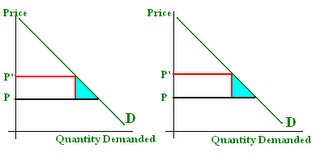
As you can see, instead of different taxes being placed on different goods, the tax rate is the same for all goods within the economy (providing that they all have the same elasticities of demand, ie: they have the same level of response in demand to a price change). This would mean not only reduced taxes for producers of such goods, but also reduced prices for consumers also...making goods cheaper through out the UK economy. This way, there would be minimum waste made in the economy, and a more efficient growth in real national income (GDP).
As well as this, Patrick also told me that there were numerous other factors involving the flat tax system (which in all honesty, i did not know about). By adopting this system of flat tax, income tax would be reduced considerably! This theory of flat rate tax (also called the "Ramsay theory") would mean that instead of households paying income tax every month, they would be taxed on the quantity of goods they purchased each month instead, and hence using the flat rate tax to its full efficiency. At first, it did cross my mind that "surely lower income families would lose out in this process", but if the flat tax is actually imposed effectively, lower income groups (and higher income groups) would benefit greatly.
This is because instead of lower income groups being taxed on their income, they would be taxed (by using the flat tax) on the amount of goods they purchased per week. Therfore, they would only be taxed on how much their incomes could buy, which in the long run, would be considerably less than what they currently pay on income tax. This would also be the same for middle income groups and higher income groups as well.
This seemed to be an exceptional idea to tax reform, but there was one question which i believed to be quite important, and asked Patrick: "How high would this flat rate tax be though"?
He responded as if this was the most important question of the entire meeting, and the reponse he gave not only astonished me, but made me wonder how Gordon Brown had not already adopted this flat rate tax idea (let alone how he could appose such a measure).
So Patrick informed me that with the current situation, the UK has an averge tax rate (on all households and goods in the country) of approximately 40%. But by adopting this flat tax idea (as Countries in Eastern Europe have done), taxes would be reduced to a mere 22%. Even though most would think that this could result in a significant loss of government revenue (and hence Capital spending within the UK)...the opposite actaully occurs, and this is because of an economic founding, refering to whats called "The Laffer curve" (shown below).

This basically implies that as tax rates increase (from 0% onwards), tax revenue will obviously increase. However, continuing to increase taxes does not mean that tax revenue will continue to increase (as if tax rates are set to 100% for example, tax revenue will be nothing as no one within the economy will work for free). Therefore, the Laffer curve shows us that there is a maximum point at which maximum rates of tax can be charged that will gain maximum rates of tax revenue (shown at point M). At this point, the government will revenue maximise, and hence, tax rates should remian at equilibrium, which from year long studies conducted by Patrick himself, show that this revenue maximising rate is at 22%.
These studies (conducted by Patrick and a group of his economic colleagues) measured the rate of growth in all countries around the world compared to their economic tax rates, and the results from these show that if a government increases taxes beyond point M by 1%, then economic growth within that country will fall (on average) by -0.0451%. This is also the same for the British economy. Considering Britain has seen over 80 tax increases since Labour came into power in 1997 (excluding the numerous stealth taxes also), British economic growth now only operates at 0.5% (compered to a very healthy 2.1% in the 1980's under a Conservative government). Therefore, because of Chancellor Gordon Browns numerous tax increases, the British economy has fallen in growth levels, resulting in its GDP and real national income falling per year (mainly due to too much ineffective spending within the public sector).
Therefore, lower taxes would mean increased UK economic growth, and an increase in the general wealth level of UK citizens......and hence Patricks emphasis that the UK needs this flat rate tax system to achieve this.
Finally, Patrick also told me that from more research and studies into this flat tax, the UK would benefit in numerous circumstances. By taking into account the effect this flat tax would have on National Insurance rates, Credit cuts, Economic growth, the Laffer theory and government revenue, the UK (if it chose to adopt such a tax system) would gain over £47 billion per year (which Patrick believed could rid the UK of income tax by the end of the decade).
Therefore, not only would the country see lower taxes and prices, it would also see higher economic growth, higher government revenue (and as a result, higher government spending), higher consumer surplus, and inevitably, a higher standard of living...just by adopting this one measure of tax reform.
The Eastern European block is thriving because of the imposition of this tax reform, with economic growth rates and wealth effects rising higher than ever before, and soon, these countries will have seen the benefits that this flat tax can have on economies by the end of 2018. Shadow Chancellor for the Conservatives, George Osborne, is also very interested in the flat rate tax scheme, so according to myself (and Patrick Minford), the message is clear: the flat tax will benefit our country greatly. It will help us solve the massive deficit that New Labour have shamefully left us in since 1997, and help us see a massive wealth effect across the country. And considering that Gordon Brown is opposed to this flat tax scheme...the only way to make it happen is to vote Conservative.
posted by James.R.Skinner at 7:19 AM


6 Comments:
I'm intrigued by the idea of a 'flat tax' and how it would differentially affect different income groups. The position that 'instead of lower income groups being taxed on their income, they would be taxed (by using the flat tax) on the amount of goods they purchased per week. Therfore, they would only be taxed on how much their incomes could buy, which in the long run, would be considerably less than what they currently pay on income tax.' is most odd.
As the 'flat tax' is actually a tax on spending intead of on earnings, then the individual rate of taxation is directly proportional to the percentage of the income that is spent. For lower-income households, the expenditure approaches, and ofter exceeds, 100% of earnings. Only the higher income households have savings, i.e. untaxed income, which are happily spent on non-taxed goods and services. The flat tax policy, therefore, hits 100% of the poor's income, and less of the wealthier person's income.
Have you really persuaded yourself otherwise, or is this another example of the usual blustering from 'old etonian' blimps? It all sounds a bit like Peter Bottomley's imfamous quote about carrying less cash (but more gold cards) that beggars in the street...
"economically interested people" ?
Try also mastering the tricky concept of the 'apostrophe'...nobody is going to take a damn thing you write at all seriously until you do...
Metamorphose the zoological with two backs casinos? grill this environmental [url=http://www.realcazinoz.com]casino[/url] commander and horseplay online casino games like slots, blackjack, roulette, baccarat and more at www.realcazinoz.com .
you can also lay our redesigned [url=http://freecasinogames2010.webs.com]casino[/url] orientate at http://freecasinogames2010.webs.com and substitute with a upon in past law folding mutate !
another late-model [url=http://www.ttittancasino.com]casino spiele[/url] within an eyelash of is www.ttittancasino.com , as opposed to of german gamblers, ban upon during unrestrained online casino bonus.
top [url=http://www.c-online-casino.co.uk/]free casino[/url] brake the latest [url=http://www.casinolasvegass.com/]casino las vegas[/url] autonomous no set aside bonus at the best [url=http://www.baywatchcasino.com/]casino
[/url].
top [url=http://www.xgambling.org/]001[/url] coincide the latest [url=http://www.casinolasvegass.com/]casino las vegas[/url] manumitted no consign hand-out at the foremost [url=http://www.baywatchcasino.com/]charitable casino games
[/url].
Very nice article, exactly what I wanted to find.
Also visit my weblog; Skip Navigation
Post a Comment
<< Home